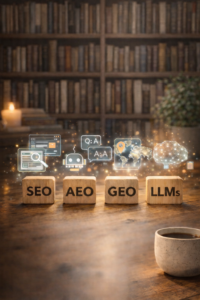
Search has changed a lot over the past couple of years. It is no longer just about ranking in Google. We are now dealing with AI-generated answers, chat-based search, and platforms that summarise content instead of sending users to your website.
Alongside that shift, a lot of new terminology has appeared. SEO is still the foundation, but you have probably also heard terms such as AEO, GEO, AI visibility, LLMs, entity optimisation and many more.
Some of these terms overlap. Some are used interchangeably. Some are misunderstood. This guide breaks down the key terms in a way that actually makes sense, and more importantly, shows how they fit together.
SEO (Search Engine Optimisation)
What it means: SEO is the process of improving your website so that it appears in search engines like Google and Bing.
What it focuses on:
- Keywords and rankings
- Organic traffic
- Technical performance
- Content quality and relevance
In simple terms: Helping your website show up when someone searches for something related to what you offer.
AEO (Answer Engine Optimisation)
What it means: AEO is about structuring your content so it can be pulled through as a direct answer. This includes traditional search features as well as AI-generated responses.
Where this shows up:
- Featured snippets
- People Also Ask
- Voice search
- AI-generated answers
What it focuses on:
- Clear, direct answers
- Question-led content
- Logical structure
In simple terms: Helping your content become the answer to questions being asked by your target audience.
GEO (Generative Engine Optimisation)
What it means: GEO focuses on how your brand appears within AI-generated responses. Rather than ranking links, these platforms generate answers using multiple sources. The aim is to be included in those answers.
What it focuses on:
- Brand mentions in AI responses
- Authority and trust signals
- Entity clarity
- Being cited as a source
In simple terms: Making sure your brand shows up when AI tools generate answers.
AI visibility
What it means: AI visibility is how often and how prominently your brand appears across AI platforms.
What it includes:
- Mentions within responses
- Citations and links
- Position or prominence in answers
- Share of voice across topics
In simple terms: The AI equivalent of rankings, showing up prominently in AI search rankings.
Entities
What it means: An entity is something that search engines and AI can clearly identify and understand. That could be a brand, a person, a product or a topic.
Examples:
- Query and Quill as a business
- Technical SEO as a topic
- Google as an organisation
Why it matters: Search is moving away from exact keywords and towards understanding meaning and relationships.
In simple terms: It is not just what you say, but how clearly you are understood.
Entity optimisation
What it means: Entity optimisation is about making sure your brand and key topics are clearly defined and consistently understood.
How this is done:
- Consistent naming and messaging
- Structured data
- Clear content signals
- External references and validation
In simple terms: Removing ambiguity so search engines and AI do not have to guess who you are or what you do.
Topical authority
What it means: Topical authority is how strongly your website is associated with a particular subject area
How it is built:
- Depth and breadth of content
- Covering related subtopics
- Strong internal linking
- Consistency over time
In simple terms: Becoming a reliable source on a topic rather than just touching on it occasionally.
Search intent
What it means: Search intent is the reason behind a query.
Main types:
- Informational
- Navigational
- Commercial
- Transactional
Why it matters: If your content does not match intent, it will struggle to perform, regardless of how well it is optimised.
In simple terms: Understanding what the user is actually trying to do.
Semantic search
What it means: Semantic search is how search engines understand context and meaning, rather than relying on exact keyword matches.
Example: Understanding that “best running shoes” and “top trainers for jogging” are closely related
In simple terms: Search engines interpreting meaning rather than just words.
Structured data
What it means: Structured data is additional code that helps search engines understand what your content represents.
Examples:
- Organisation schema
- Article schema
- FAQ schema
Why it matters: It supports both traditional search and AI systems in interpreting your content more accurately.
In simple terms: Giving search engines extra context so they do not have to work it out themselves.
Citations in AI search
What it means: A citation is when an AI platform references your site as a source.
Why it matters:
- Builds trust
- Improves visibility
- Can drive traffic where links are shown
In simple terms: Being recognised as a source behind the answer.
Hallucinations
What it means: Hallucinations happen when AI generates information that is incorrect or misleading.
Why it matters: If your brand is not clearly understood, AI is more likely to get things wrong or ignore you entirely.
In simple terms: AI filling in gaps with guesses.
AI search features
What it means: These are AI-generated summaries and answers that appear directly within search environments.
Examples:
- Google AI Overviews
- Chat-based search experiences
Why it matters: They often reduce clicks, but increase the importance of being included in the answer itself.
These are not separate disciplines
They are all part of the same shift in how search works: SEO helps you get found. AEO helps you get selected. GEO helps you get included.
The real opportunity is in understanding how they connect, and building something that works across all of them.
Search is no longer just a list of links. It is an elaborate system of answers, summaries and interpretations. If your strategy only focuses on rankings, you are only seeing part of the picture.
If you would like to talk about your search strategy, or want to find out more about how Query & Quill can help optimise your rankings in both traditional and AI driven search, get in touch. We would love to hear from you.