
Search is changing.
People are no longer just clicking through a list of blue links - they’re asking questions, getting summarised answers and discovering brands directly within AI-generated responses.
Platforms like ChatGPT, Google AI Overviews, Perplexity and Gemini are reshaping how visibility works. And if your brand isn’t showing up in those answers, you’re already missing opportunities.
Optimising for AI search isn’t about replacing SEO. It’s about evolving it.
What is AI search (and why it matters)
AI search refers to platforms that generate answers rather than just listing results. Instead of "Here are 10 blue links to relevant websites", users now get direct answers to their questions, alongside a list of sources.
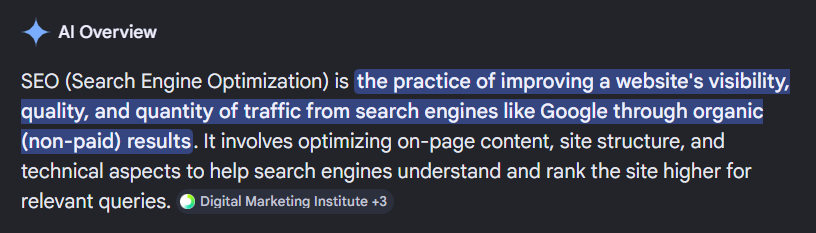
That changes everything. Visibility is no longer just about rankings. It’s about:
- Whether your brand is mentioned.
- Whether your content is cited.
- Whether AI systems understand who you are and what you do.
How AI models decide what to show
AI systems don’t "rank" pages in the traditional sense. They:
- Interpret content.
- Identify entities (brands, topics, concepts).
- Pull from sources they trust and understand.
- Generate responses based on that understanding.
That means your visibility depends on three things:
- Clarity: how clearly your site explains what you do.
- Authority: how credible and consistent your content is.
- Structure: how easy your content is for machines to interpret.
Top tips on helping your brand show within AI search results
1. Make your brand and offering unmistakably clear
If an AI model can’t confidently describe your business, it won’t include you. Your website should clearly answer:
- What do you do?
- Who do you do it for?
- What problems do you solve?
What to focus on:
- Clear, consistent messaging across key pages.
- Strong, descriptive headings (not vague marketing language).
- Dedicated pages for core services (not everything crammed into one page).
If your homepage could apply to multiple businesses, it’s not clear enough.
2. Build strong entity signals
AI models rely heavily on entity understanding, not just keywords. They look for brand names, key people, topics, services and the relationships between them.
How to strengthen this:
- Use consistent naming (don’t vary your service names everywhere).
- Mention key topics repeatedly and naturally across your site.
- Create content clusters around core themes (e.g. AI SEO, technical SEO, content strategy).
- Implement structured data (Organisation, Service, Article).
- Use "about" and "mentions" where relevant.
- Link to authoritative external sources where it makes sense.
This helps AI systems connect the dots and understand your expertise.
3. Create content that answers real questions
AI search is driven by questions. If your content doesn’t directly answer them, it won’t be used. Focus on:
- Clear, question-led headings.
- Concise, direct answers within content.
- Covering topics in full (not surface-level).
Example: Instead of "Why SEO is important", go deeper. Use phrases such as "What is SEO in 2026?", "How does AI change SEO?" and "What should businesses prioritise?".
AI models favour content that is specific, complete and easy to extract answers from.
4. Structure your content for machine readability
Even great content won’t perform if it’s hard to interpret. Best practices include:
- Use clear heading hierarchies (H1, H2, H3).
- Break content into logical sections.
- Use bullet points and lists where helpful.
- Avoid overly complex or fluffy language.
Think... "Can this be easily summarised?" Because that’s exactly what AI systems are doing.
5. Demonstrate authority and credibility
AI models don’t just look at your site, they look at the wider web. They want to understand:
- Are you a trusted source?
- Are you referenced elsewhere?
- Do you demonstrate expertise?
Ways to build this:
- Publish high-quality, original insights (not generic content).
- Include real examples, frameworks or data.
- Ensure consistency across your site and external profiles.
- Earn mentions and links from relevant sites.
If your content could have been written by anyone, it won’t stand out.
6. Track and measure AI visibility (not just rankings)
Traditional SEO metrics aren’t enough anymore. You also need to understand:
- Where your brand appears in AI-generated responses.
- How often you’re mentioned vs competitors.
- Whether you’re being cited as a source.
Emerging AI metrics to track:
- Brand mentions in AI responses.
- Citation frequency.
- Topic-level visibility.
- Share of voice across AI platforms.
This is where SEO is heading, and where most businesses aren’t looking yet.
7. Align your SEO strategy with AI search
This isn’t a separate channel. It’s an evolution of search. The most effective approach combines:
- Technical SEO foundations.
- Strong content strategy.
- Clear entity and brand positioning.
- AI-specific optimisation.
If any one of these is missing, your visibility can be limited.
Optimising for AI search isn’t about chasing algorithms
It’s about making your website clear, credible, structured and useful. The brands that win in this space will be the ones that:
- Communicate what they do without ambiguity.
- Build strong topical authority.
- Create genuinely helpful content.
- Are easy for both humans and machines to understand.
Want to understand how visible you are in AI search?
If you’re unsure how your brand currently shows up across platforms like ChatGPT, Google AI Overviews and Perplexity, we can help.
Our AI visibility reports uncover:
- Where you appear (and where you don’t).
- How your brand is being interpreted.
- What’s holding you back.
And most importantly, what to do next. Get in touch to find out more about our AI SEO Services, we'd love to hear from you.